Big Ideas, Real Impact.
Follow along with the RISING coalition as they work to implement resilience strategies. Explore past RISING events below, or click on upcoming events to see our plans for building a more resilient future.
Recorded on September 8, 2026
RISING Webinar Series
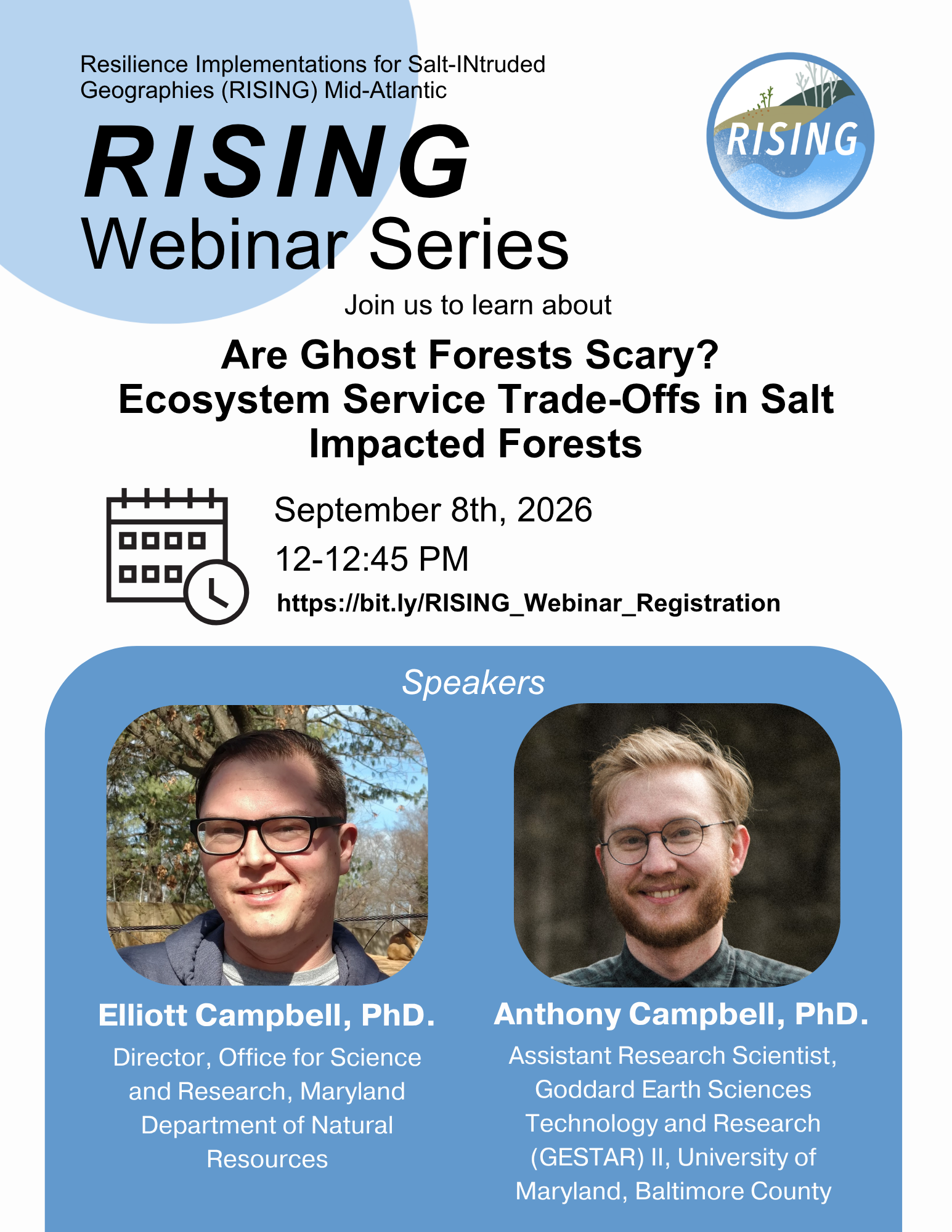
Elliott Campbell, PhD. Director, Office for Science and Research, Maryland Department of Natural Resources & Anthony Campbell, PhD. Assistant Research Scientist, Goddard Earth Sciences Technology and Research (GESTAR) II, University of Maryland, Baltimore County present “Are Ghost Forests Scary? - Ecosystem Service Trade-Offs in Salt Impacted Forests” at the September 2026 RISING Webinar.
Resources
Recent publication by Dr. Campbell and Dr. Campbell:
Campbell & Campbell, 2026: The case for and against Phragmites australis: an ecosystem service cost–benefit analysis for Chesapeake Bay marshes.
Select journal articles referenced in the presentation:
Gibson et al., 2021: Identification, Mitigation, and Adaptation to Salinization on Working Lands in the U.S. Southeast
Yeung et al., 2025: Overlooked and extensive ghost forest formation across the US Atlantic coast
Kirwan et al. 2023, Geomorphic and ecological constraints on the coastal carbon sink
Tully et al., 2019: Soils in transition: saltwater intrusion alters soil chemistry in agricultural fields
Presentation Description: Forests experiencing degradation and die-off due to saltwater intrusion, or “ghost forests”, are prevalent on the Delmarva Peninsula and growing rapidly. The area of ghost forest in Maryland has doubled over 10 years, going from ~35,000 acres in 2014 to over 70,000 acres in 2024, with the majority of that area experiencing “severe” impact (>50% mortality). This change has resulted in a novel ecosystem where coastal forests are transitioning to wetlands, often dominated by Phragmites australis, an invasive species common throughout our region. We discuss how the ecosystem services these systems provide change during transition and potential management actions for maximizing ecological benefits.
Recorded on August 11, 2026
RISING Webinar Series
John Zander, Owner of Cohansey Meadows Farms, presents “Cohansey Meadows Farms: Overcoming and Adapting to Saltwater Intrusion” at the August 2026 RISING Webinar.

Presentation Description: When saltwater intrusion creeps into crop fields, standard farming stops working. Instead of letting those flooded acres sit unproductive, Cohansey Meadows Farms adapted by developing Salt Water Intrusion Zone (SWIZ) agricultural practices. In this talk, I’ll share our real-world experience cultivating salt-tolerant native crops, harvesting live plant plugs for restoration projects, the unique crop of salt hay and its production, and turning degraded "agricultural voids" back into profitable, working land.
Recorded on July 14, 2026
RISING Webinar Series
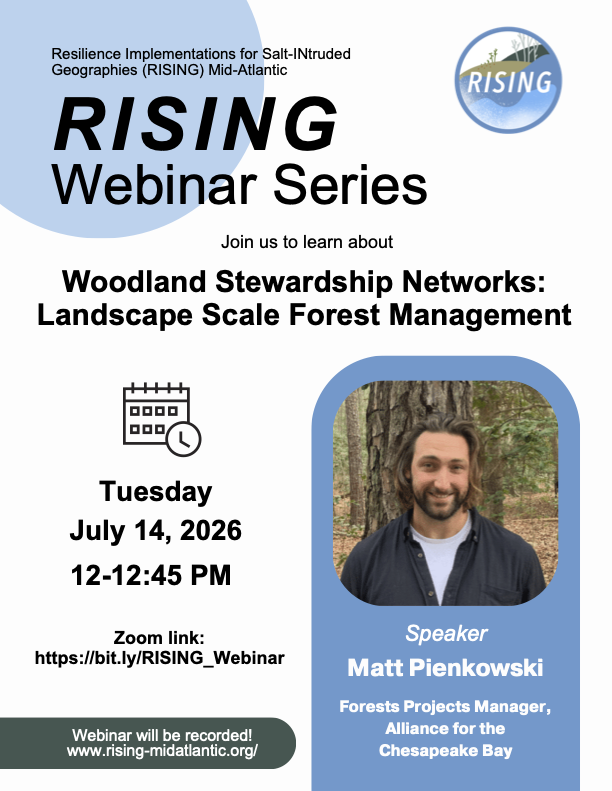
Matt Pienkowski, Forests Projects Manager with the Alliance for the Chesapeake Bay, presents “Woodland Stewardship Networks: Landscape Scale Forest Management” at the July 2026 RISING Webinar.
Resources
Find out more information on the Woodland Stewardship Networks through the Alliance for the Chesapeake’s website!
https://www.allianceforthebay.org/project/woodland-stewardship-networks/
Presentation Description: Learn about the Alliance for the Chesapeake Bay's Woodland Stewardship Network model, and its application on adjacent forested properties for landscape level impacts.
Recorded on June 9, 2026
RISING Webinar Series
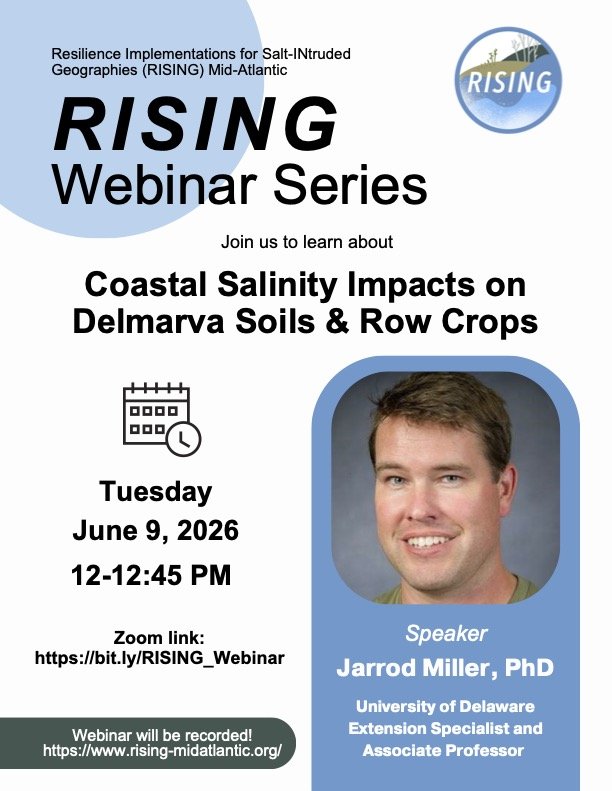
Dr. Jarrod Miller, University of Delaware Extension Specialist and Associate Professor, presents “Coastal Salinity Impacts on Delmarva Soils and Row Crops” at the inaugural RISING Webinar.
Resources
Dr. Jarrod Miller’s website: https://sites.udel.edu/delmarvasalt/
Referenced Publications:
Pokhrel et al., 2026: Application of routine Mehlich-3 and EC ratio tests for salinity and sodicity management in Delmarva coastal croplands
Pokhrel et al., 2025: Evaluating routine agronomic soil tests for coastal soil salinity detection in the mid-Atlantic
Miller et al., 2025: Coastal stressors reduce crop yields and alter soil nutrient dynamics in low-elevation farmlands
Presentation Description: Coastal soil salinity is a spatially variable limitation in agricultural systems across the Delmarva Peninsula, influencing crop establishment, stand persistence, and yield stability in row crop production. This presentation combines multi-year field research from the Delmarva research group examining crop responses across affected landscapes, with emphasis on practical implications for agricultural decision-making. Evaluations include sorghum, soybean, and barley performance under coastal saline conditions as well as how soil testing and spatial mapping approaches can be used to characterize salinity and improve interpretation of crop response in affected areas. The goal is to translate research findings into actionable insights for identifying productive areas, improving interpretation of soil salinity data, and supporting management decisions in coastal agricultural systems.
RISING Cross-State Workshop
Held on February 18th, 2026
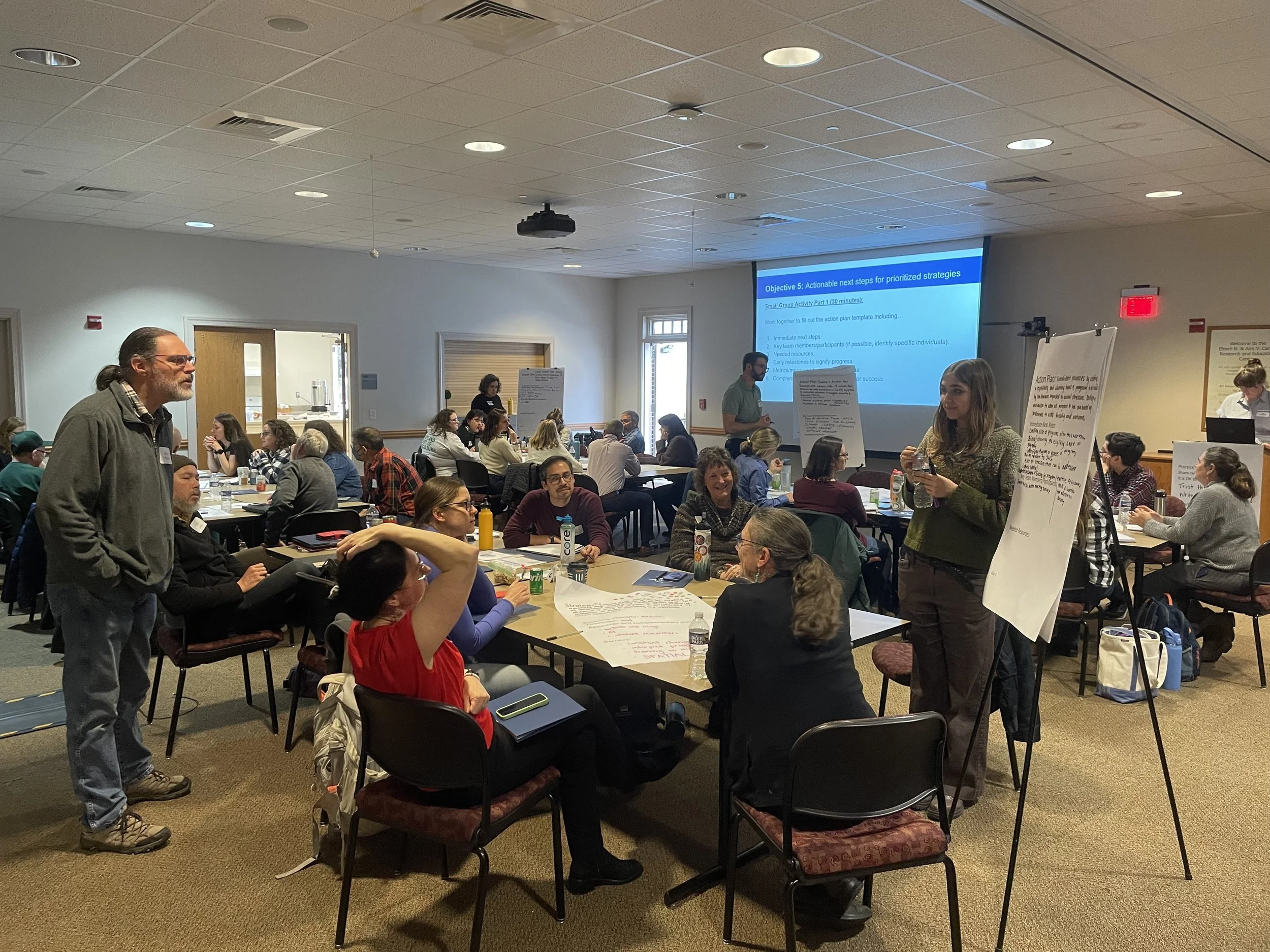
University of Delaware Carvel Research and Education Center Georgetown, DE
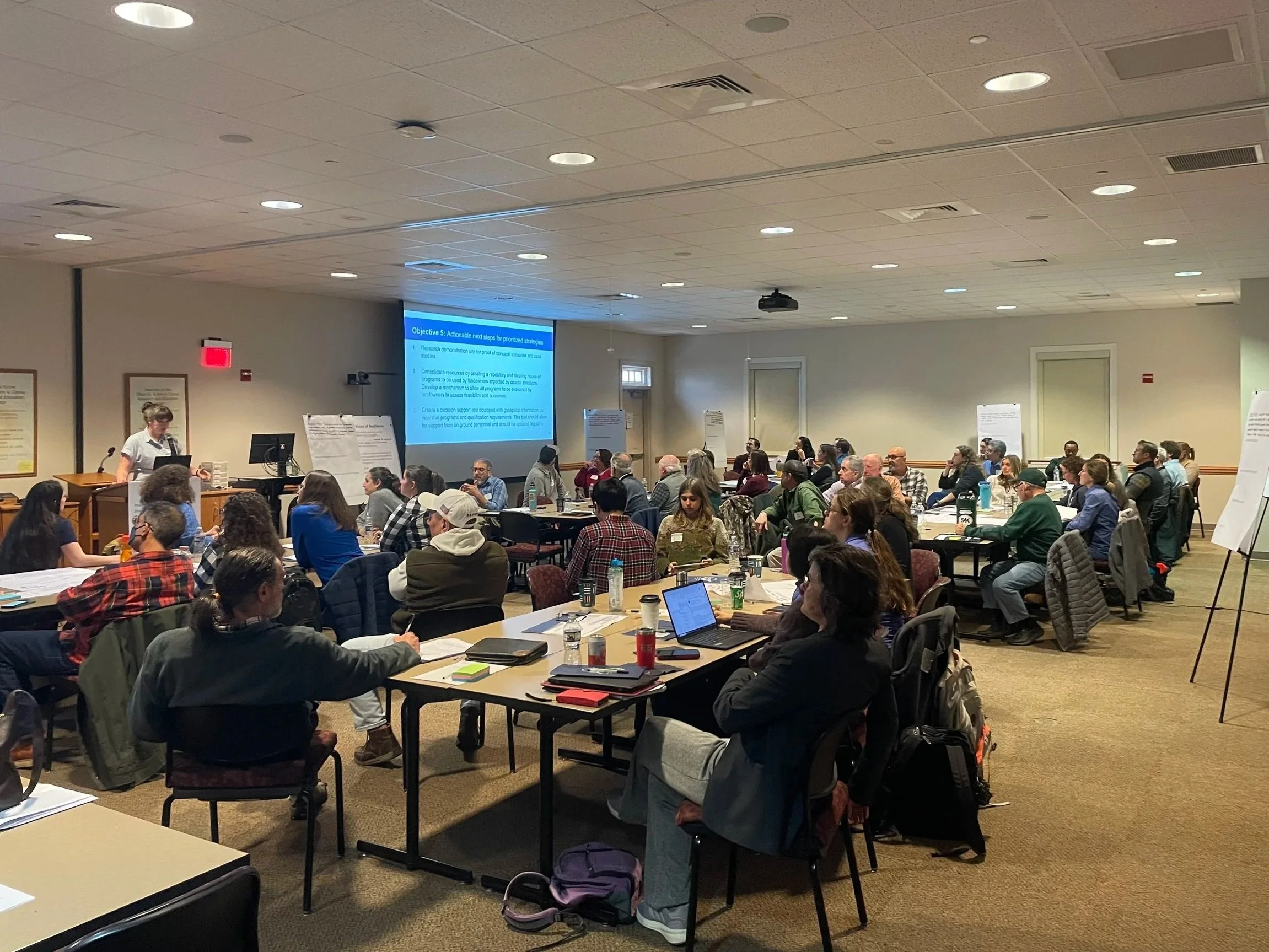
A total of 56 participants joined us from different sectors across Maryland, Delaware, and New Jersey.
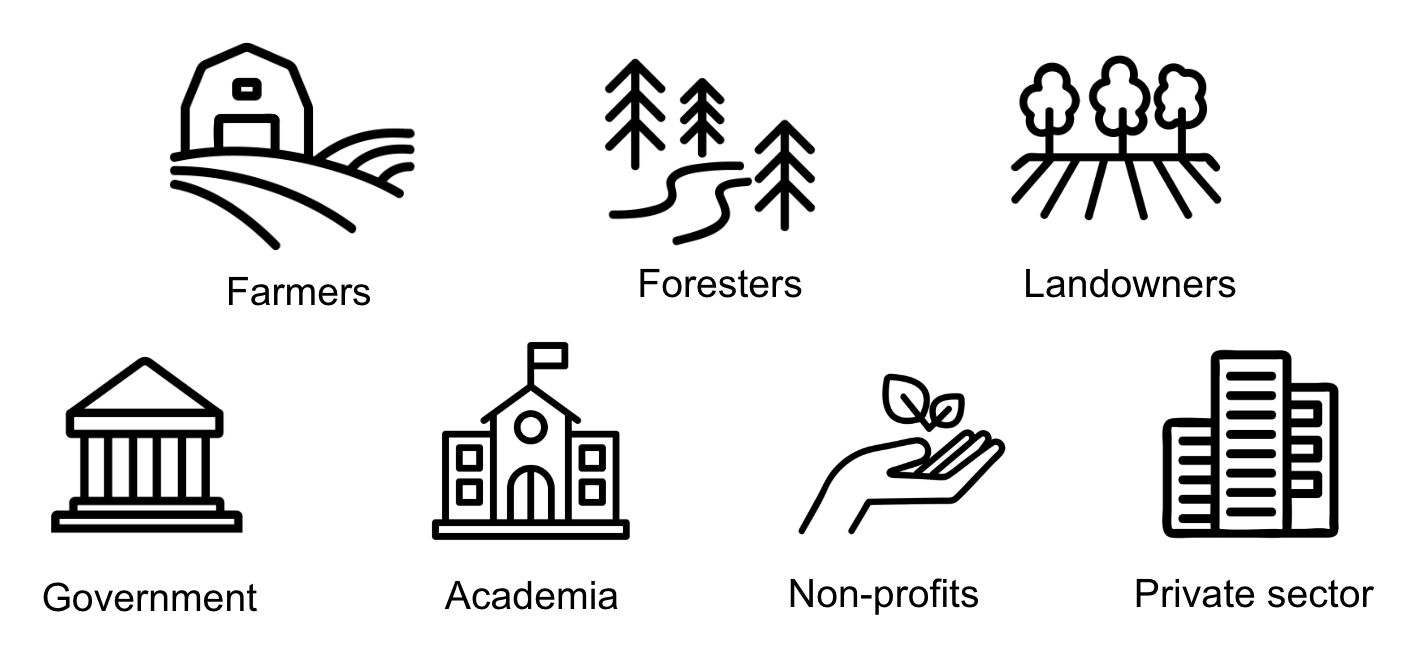
Participants worked together to develop a shared vision of resilience and actionable strategies to address saltwater intrusion and other coastal stressors.
RISING Resilience Vision Statement
RISING defines resilience as the ability for communities to…
Recover, adapt, and manage the impacts of coastal stressors.
Be proactive and make decisions to protect ecosystem functionality that support livelihoods and enhance well-being in the immediate future and long-term.
Completed February 18th, 2026.
Prioritized Strategies
Strategy 1: Research demonstration site for proof of concept/ scenarios and case studies.
Strategy 2: Consolidate resources by creating a repository and clearing house of programs to be used by landowners impacted by coastal stressors. Develop a mechanism to allow all programs to be evaluated by landowners to assess feasibility and outcomes.
Strategy 3: Create a decision support tool equipped with geospatial information on incentive programs and qualification requirements. This tool should allow for support from on ground personnel and should be updated regularly.
Strategy 4: Create a network to identify priority research on private coastal lands to inform policy. Develop scopes of work and apply for funding
Strategy 5: Create stronger linksamong science, impacted communities, and policy-makers to adapt to coastal stressors.
Strategy 6: Develop a decision tree framework with resources, information, and contacts that enables landowners to identify symptoms of SWI and navigate technical and financial resources.
Strategy 7: Create resources and training opportunities for legislators and decision makers at different scales (local, state, federal) to promote understanding of and responsiveness to coastal stressors.
Strategy 8: Identify, connect, and incentivize early-adopters of conservation, financial support, and other funded programs to facilitate the establishment of “community technical ambassadors” who can advocate for private landowners.
Completed February 18th, 2026.
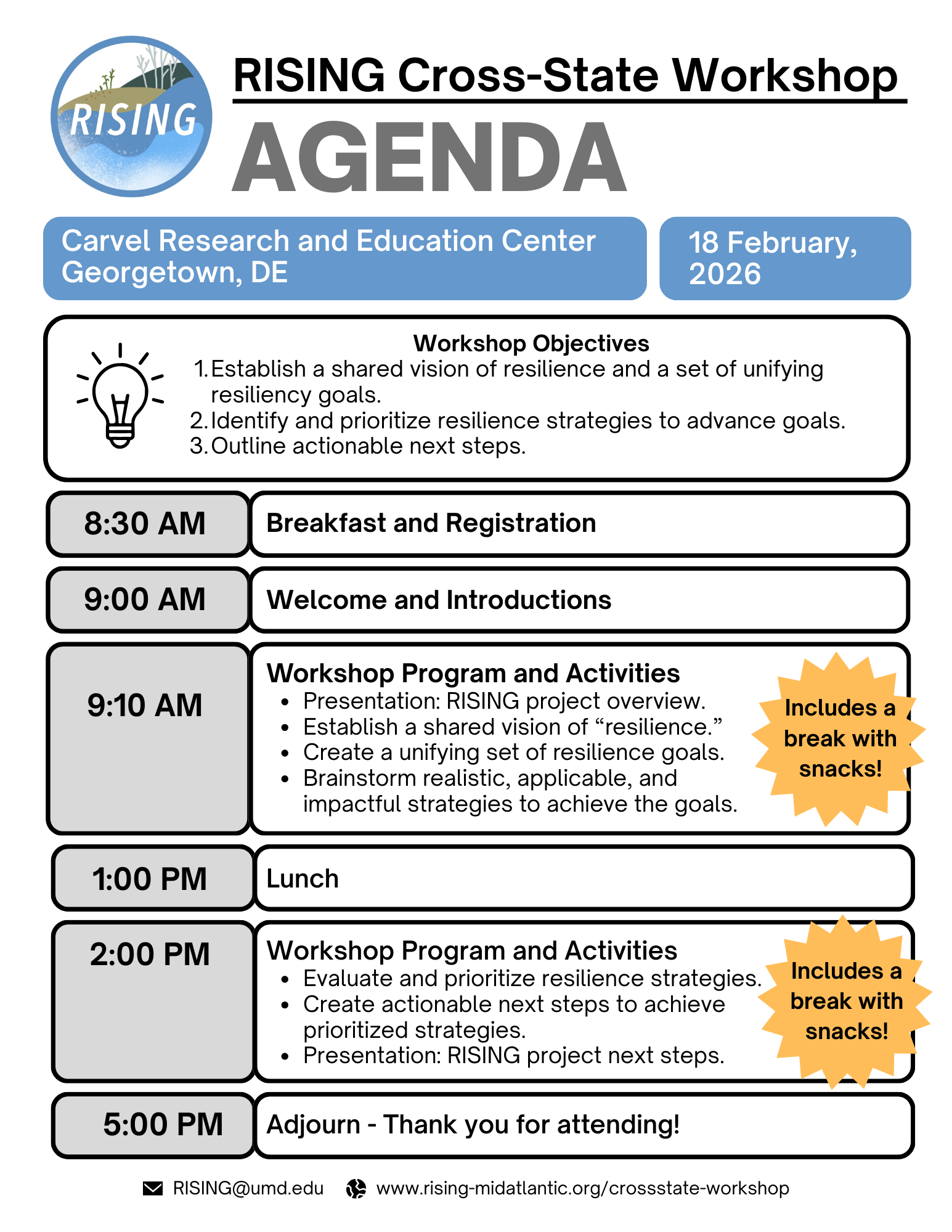
Workshop Agenda
Next Step: RISING Working Groups turn strategies into action!